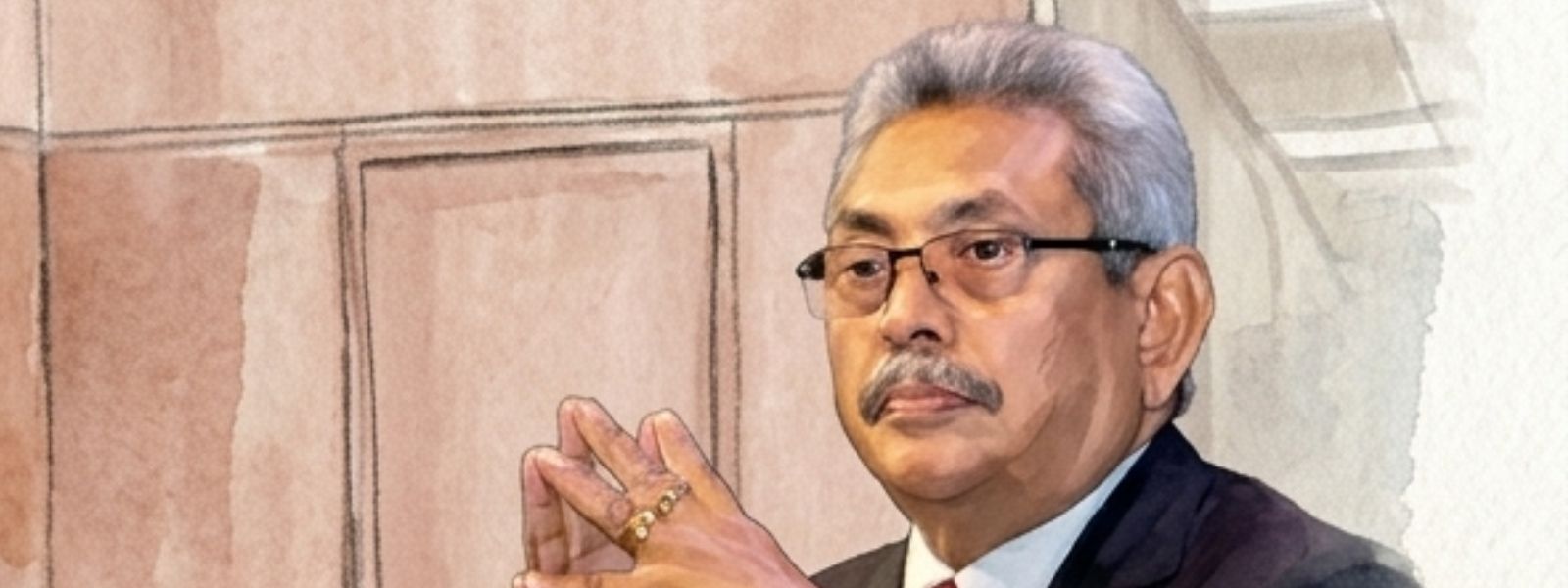
COLOMBO (News 1st);The hearing of the writ petition filed by former President Gotabaya Rajapaksa, seeking an order preventing his arrest in connection with investigations into the Easter Sunday terror attacks, commenced today (18) before the Court of Appeal.
The petition was taken up before a bench comprising Court of Appeal President Judge Rohantha Abeysooriya and Judge Sarath Dissanayake.
During the proceedings, President’s Counsel Romesh de Silva, appearing for the petitioner Gotabaya Rajapaksa, informed court that the Constitution recognizes judicial independence as well as personal liberty as fundamental rights.
He stated that such liberty can only be restricted under very limited circumstances, and delivering justice to the victims of the Easter attacks does not mean arbitrarily arresting and imprisoning individuals without a reasonable basis.
The President’s Counsel further stated that the law permits arresting and remanding individuals only in exceptional circumstances, and remanding a person should not become a punishment in itself.
He also told court that his client had not been summoned for any investigation related to the Easter attacks and had not interfered with any witnesses connected to the inquiry.
Against such a backdrop, the President’s Counsel alleged that the respondents had obtained a foreign travel ban against his client from the Colombo Fort Magistrate’s Court without any reasonable basis, thereby restricting his liberty through an unjustified investigation.
He further stated, if his client is arrested under the Prevention of Terrorism Act, he would be deprived of the opportunity to obtain bail, and it is for this reason that the petitioner has come before this court.
At this point, Judge Sarath Dissanayake raised a question, asking whether such legal provisions are used in situations where an investigation cannot be completed within 24 hours.
Responding to this, the President’s Counsel stated that such laws cannot be used to deprive an individual of personal liberty.
President’s Counsel de Silva also pointed out that the Presidential Commission of Inquiry, chaired by current Supreme Court Judge Janak de Silva and appointed to investigate the Easter Sunday attacks, had recorded evidence from 257 individuals over a period of 214 days.
He emphasized that although the Commission had submitted a six-volume report, there is not a single reference to the petitioner anywhere in that report.
He further stated that the Jayaki de Alwis Commission, which also examined the Easter attacks, had recommended that criminal proceedings be instituted against former Director of the Criminal Investigation Department Shani Abeysekara and former Deputy Inspector General Ravi Seneviratne for failing to prevent the attacks.
The President’s Counsel stressed that despite evidence pointing to the involvement of a foreign terrorist organization behind the 2018 Mawanella Buddha statue vandalism incidents, former CID Director Shani Abeysekara had failed to seek Interpol assistance for further investigations.
He alleged, despite such negligence, the same individual is now attempting to unlawfully arrest his client.
He added that it is problematic that such an individual is currently serving as the Director of the Criminal Investigation Department and leading the Easter Sunday investigations.
The President’s Counsel also stated that requests are being made to the Attorney General’s Department to arrest various individuals in this manner, adding that the department itself has now been placed in a difficult position.
At this stage, Deputy Solicitor General Suharshi Herath, appearing for the respondents, objected, stating that the learned President’s Counsel was attempting to portray the Attorney General’s Department as a puppet and that such statements were being made purely for media purposes.
Rejecting this allegation, the President’s Counsel clarified that he had never accused the Attorney General personally, but maintained that the department had been placed in such a situation.
The Court of Appeal subsequently fixed June 24 as the next date to continue hearing the petition.