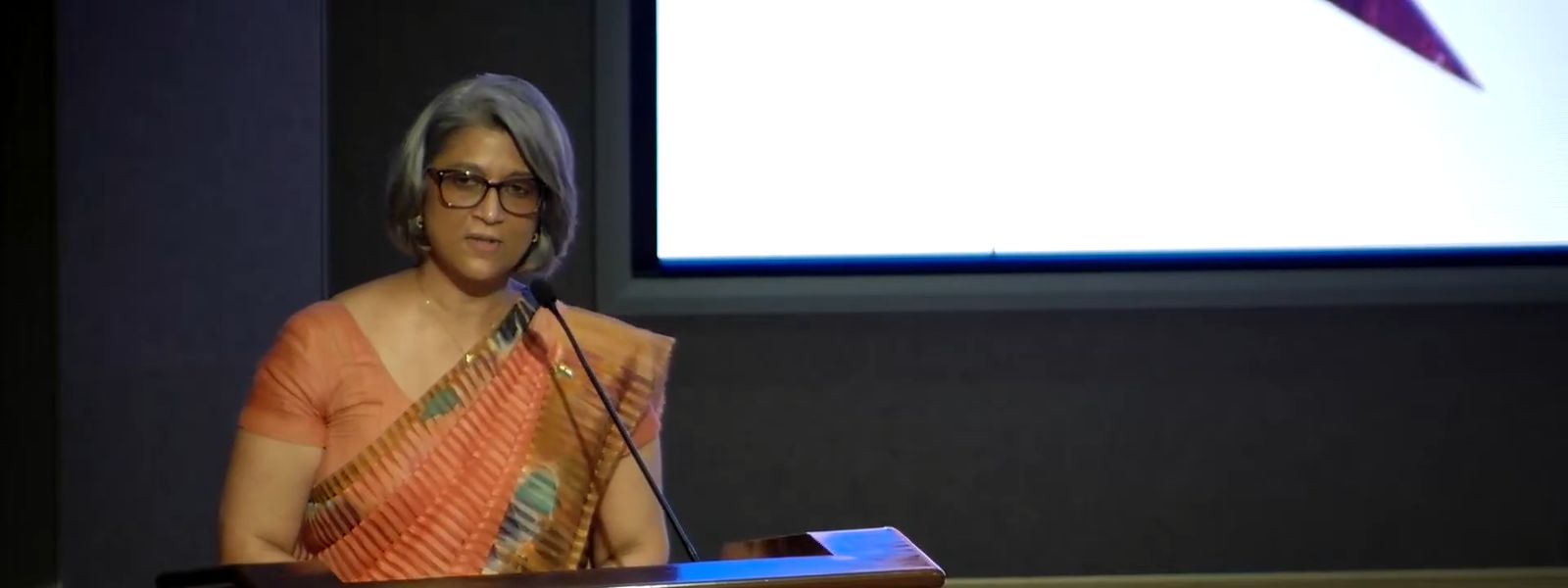
COLOMBO (News 1st); Wars fought thousands of kilometres away can reach ordinary households through rising fuel prices, disrupted shipping routes and mounting economic pressures, Sri Lanka's High Commissioner to India, Mahishini Colonne, has warned, arguing that the Indian Ocean can no longer be viewed as a region insulated from conflicts elsewhere in the world.
Speaking on the growing strategic importance of the Indian Ocean, Colonne pointed to the vulnerability of critical maritime chokepoints, including the Strait of Hormuz, Bab el-Mandeb and the Strait of Malacca, warning that disruption at any of these passages could trigger consequences far beyond the immediate conflict zone.
"A disruption in any of them can rapidly become a global economic shock. Energy prices rise. Shipping and insurance costs climb. Supply chains break. And, in the end, ordinary people feel the consequences," she said.
Her warning was highlighted by the sinking of an Iranian frigate off Sri Lanka's southern coast near Galle in March, while the vessel was returning from a naval exercise hosted by India amid the widening conflict in West Asia.
In an incident that brought the realities of international conflict directly into Sri Lankan waters, the Sri Lankan Navy responded to the vessel's distress call before dawn and rescued 32 sailors.
Colonne said Sri Lanka had acted in accordance with its obligations under international law, which require the rescue of people in distress at sea, regardless of the circumstances.
But the incident carried a wider message for countries bordering the Indian Ocean.
"The Indian Ocean is no longer insulated from the wars of others," she said.
The consequences, she noted, were not confined to the immediate maritime incident. Within weeks, households across Sri Lanka were feeling the economic effects of the conflict through fuel prices, demonstrating how instability in one part of the world can quickly translate into financial pressure elsewhere.
For Colonne, this underlines a fundamental shift in how countries must approach the Indian Ocean. Maritime security, she argued, can no longer be treated as a separate concern from trade, economic stability and national prosperity.
A disruption to shipping routes can drive up transport and insurance costs, threaten energy supplies and undermine the supply chains on which economies depend. Countries that rely heavily on maritime trade and imported energy are particularly exposed to such shocks.
She argued that the relationship between security and prosperity works in both directions: secure maritime routes facilitate trade, trade generates wealth, and economic prosperity builds the resilience needed to withstand future crises. Equally, a maritime security crisis can rapidly develop into an economic crisis.
The implications are particularly important for India and Sri Lanka, whose geographical proximity and dependence on the Indian Ocean place their economic and strategic interests closely together.
Colonne maintained that the next phase of bilateral relations must recognise this reality, bringing maritime security and maritime commerce into a common framework rather than treating them as separate policy concerns.
Her remarks carry a pointed message for the wider region: the security of the Indian Ocean is no longer simply about protecting territorial waters or safeguarding naval interests. It is also about protecting energy supplies, commercial shipping, regional economies and the everyday lives of millions of people.
"That is why the next phase of India–Sri Lanka relations must treat maritime security and maritime commerce as parts of the same strategic equation," she said.