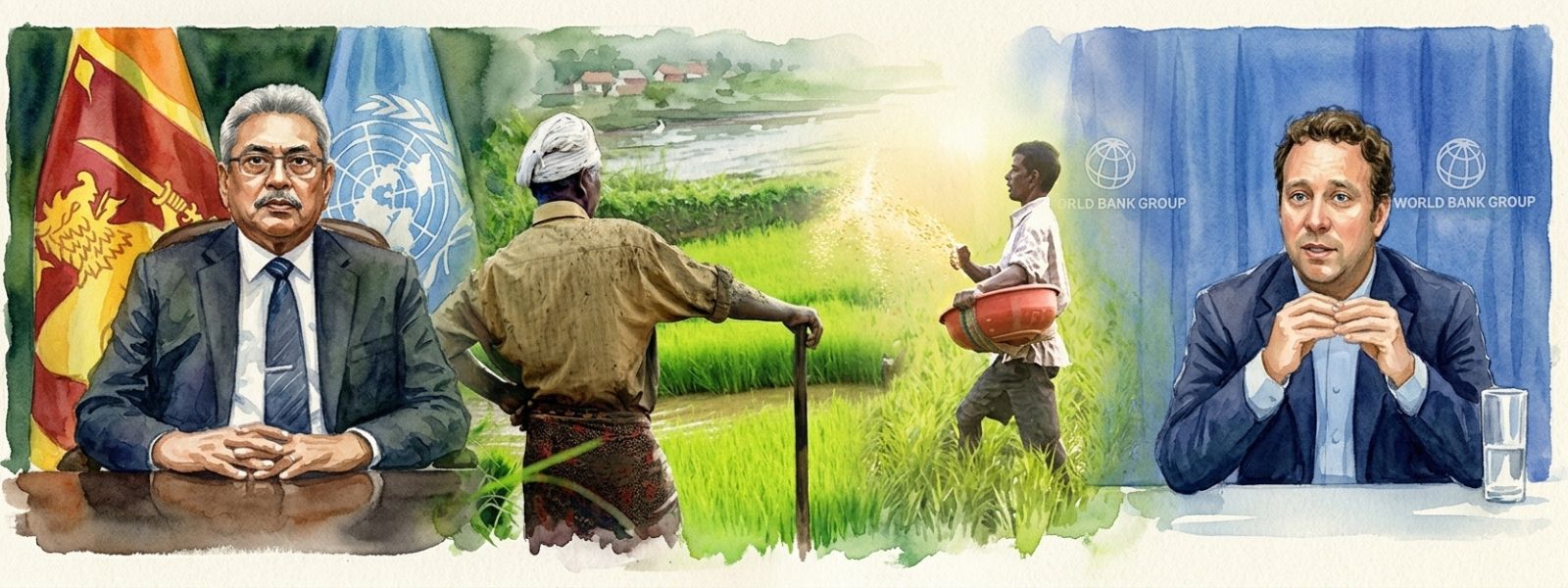
COLOMBO (News 1st) - A policy that was once promoted as a bold transformation of Sri Lanka's agricultural sector has once again entered the national conversation, after a senior World Bank economist reflected on the country's controversial fertilizer ban while responding to a question raised during a media briefing on Sri Lanka's future agribusiness policies.
The discussion traces its roots back to 2021, when the government led by then-President Gotabaya Rajapaksa introduced one of the most far-reaching agricultural policy changes in the country's history by restricting the import of chemical fertilizers, pesticides and weedicides.
Defending the policy at the United Nations Food Systems Summit on September 24, 2021, Gotabaya Rajapaksa argued that decades of increasing use of chemical inputs had resulted in adverse health and environmental consequences.
At the time, he described the import restrictions as a "bold step" aimed at transforming Sri Lanka's food system and steering the country towards organic agriculture.
However, even while defending the policy, Rajapaksa acknowledged the challenges involved. He noted that farmers who had relied on chemical fertilizer for generations were reluctant to abandon established cultivation methods, while domestic production of organic fertilizer remained insufficient to meet national demand.
The government maintained that the transition to organic agriculture would strengthen food security, improve nutrition, reduce rural poverty and create a more sustainable agricultural model over the long term.
The policy, however, quickly became one of the most debated and controversial decisions taken in the months leading up to Sri Lanka's economic crisis.
Farmers across several agricultural regions reported difficulties adapting to the sudden transition, concerns emerged over crop yields, and industry stakeholders repeatedly called for a more gradual approach. As economic pressures intensified, the fertilizer ban increasingly became part of wider public and political discussions surrounding policy decisions taken during the period that preceded Sri Lanka's worst economic crisis in decades.
Five years later, the issue resurfaced during a World Bank media briefing held in Colombo following the release of the institution's latest economic assessment of Sri Lanka.
During the briefing, journalists asked World Bank Senior Economist Jakob Engel what policy direction the institution believes the current government should pursue in relation to agribusiness and agriculture, noting that the blanket fertilizer ban introduced by the previous administration is widely viewed as one of the factors that contributed to Sri Lanka's economic difficulties before the crisis deepened.
Responding directly to the question, Engel said the fertilizer ban had ultimately "proven to be a bad decision," but stressed that the broader lesson extends beyond a single policy measure.
According to Engel, Sri Lanka's fertilizer policy has undergone multiple changes over the past several decades, creating uncertainty for farmers, investors and businesses operating within the agricultural sector.
He argued that agricultural policy should be designed around what is best for production, farmers, the economy and environmental sustainability. At the same time, he emphasized that frequent policy reversals can undermine confidence and create uncertainty throughout the sector.
Engel stressed that those participating in agriculture need predictability and a clear understanding of the policy direction not only today but also in the years ahead.
The World Bank economist said policy decisions should be grounded in the best available evidence while maintaining consistency over time, rather than shifting repeatedly between different approaches.
Beyond the fertilizer debate, Engel also outlined what he believes should be the priorities for Sri Lanka's agricultural future.
According to him, reforms should focus on creating a level playing field for exporters, eliminating anti-export biases, improving productivity, strengthening logistics networks and compliance infrastructure, and improving the functioning of land, finance, credit and insurance markets that support the agricultural sector.
His remarks did not form part of the World Bank's published report, but were made in response to a question raised during the media briefing regarding the lessons learned from Sri Lanka's fertilizer ban and the policies needed to support future agricultural growth.
As Sri Lanka seeks to move from economic recovery towards long-term transformation, the exchange highlighted a key policy debate that continues to shape the country's agricultural sector: how to balance environmental sustainability, food security, productivity and farmer livelihoods without creating the uncertainty and disruption that many critics say accompanied the fertilizer ban.
Five years after the policy was introduced, the debate surrounding Sri Lanka's organic agriculture experiment remains one of the most significant case studies in the country's recent economic history, with policymakers, economists and farmers continuing to draw lessons from its impact on agriculture, growth and economic stability.